
Darren Day
Darren Day
- August 6, 2026
- Posted by: Sitefun
- Category: News

The Continental T launched a revolution for Bentley. And it started on the button.
DESIGN
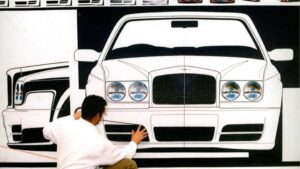 Breaking the mould
The old school tie brigade must have hated the Continental T. With its shortened wheelbase, bulging wheel arches and turbocharged 400bhp V8, it elbowed aside any notion of Bentley understatement. In stance, style and attitude it was closer to NASCAR racer than luxury limousine.
Opening the driver’s door revealed an even greater affront to tradition. Instead of a traditional burr walnut fascia, the Continental T hit you in the eyes with a door-to-door expanse of engine-turned aluminium. There was even a red starter button. Sacrilege.
POWER
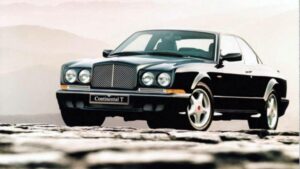 Return of the Blower
By the mid-1990s, Bentley’s renaissance was under way. The Turbo R, launched in 1985, had brought performance back. Its turbocharged 6 ¾ litre V8 gave it a 0-60 time to match contemporary two-seater exotica. The press acclaimed ‘The return of the Blower Bentley’.
In 1991 came the Continental R, the first production Bentley with its own bodystyle in four decades. On the day of its unveiling at the Geneva Motor Show, Bentley filled its order books for the next two years.
The Continental T pushed the boundaries. “Mulliner Director Jim Orr decided to create a limited edition,” explains Day. “He chopped four inches out of the wheelbase of a Continental R and handed it over to me with a simple instruction: ‘Go and create a beast’.” Orr estimated that such an extreme Bentley might justify a run of ten vehicles.
EVOLUTION
 The Beast 2.0
Working on the Continental T gave Darren Day’s career a new focus. “I loved working on the interior,” he notes. “Not just the fascia, but the upholstery and trim too. We pioneered a three-tone interior on the Continental T; green, butterscotch and tan. Up till then, most Bentleys were trimmed in magnolia.”
A second-generation Continental T featured a matrix grille and a 420bhp V8. The interior design evolved, too. “With the original Continental T we hedged our bets,” explains Day. “We included straight grain mahogany on the door waistrails and the centre console, where the starter button was sited. For the second generation we used a darker shade of engine-turned aluminium but no wood at all. We also relocated the starter button to a prime position in the middle of the dash, surrounded by dials.”
Leave a Reply
You must be logged in to post a comment.